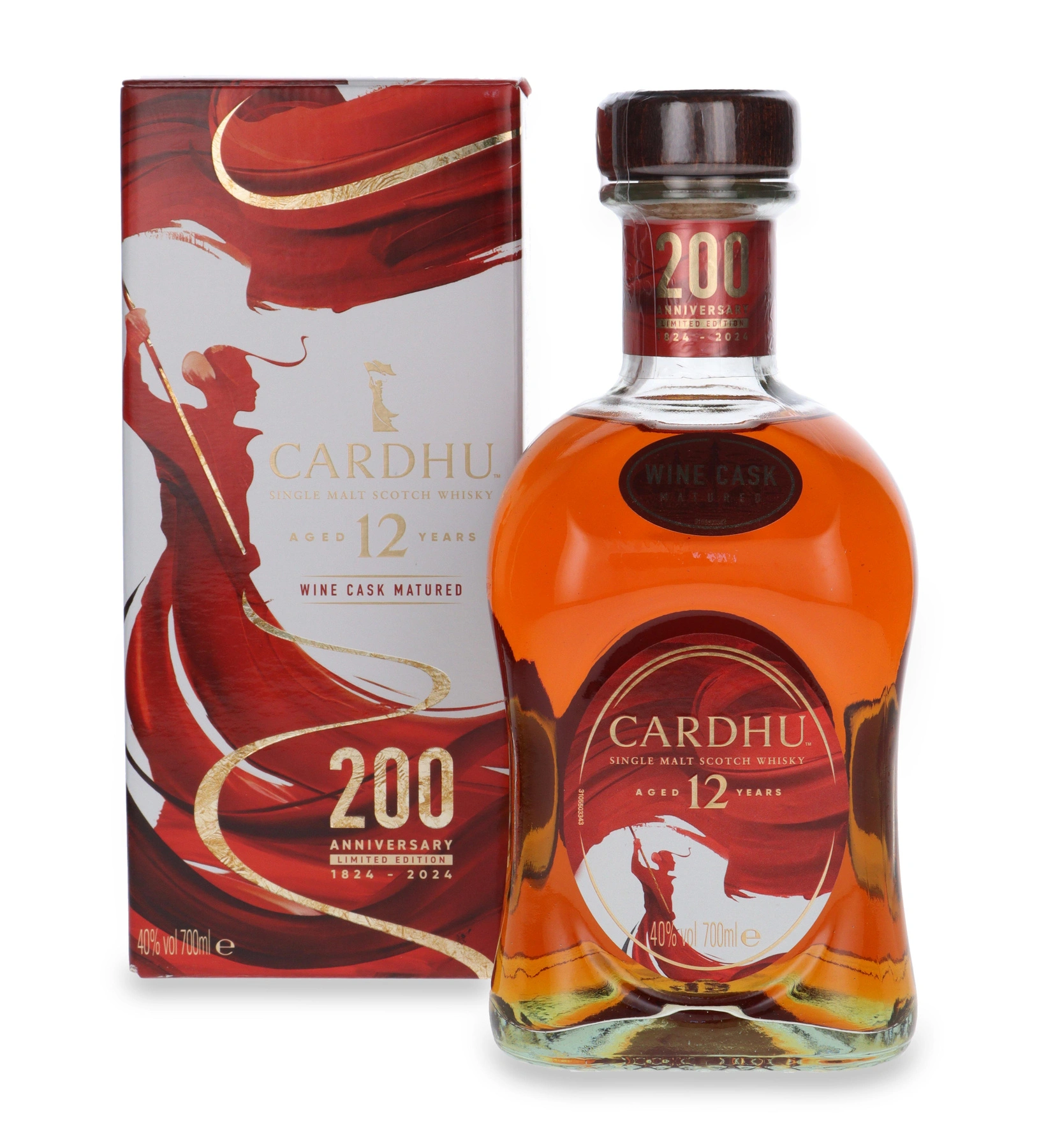
Cardhu
Speyside
Scotland
Besitzer:
Diageo
Kernabfüllungen
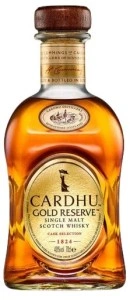
Über
An intense grassy distillery character dominates Cardhu, with orange and chocolate tones being added during maturation. This is achieved through clear wort, long fermentations, slow distillation encouraging plenty of interaction with copper and condensers which are run warm.
Geschichte
One of the oldest distilleries in Speyside, Cardhu (at that point Cardow) started life as a farm whose ‘tack’ was taken by John Cumming and his wife Helen in 1811. They soon started making illicit whisky – research suggests it was Helen who was in charge of operations – and operating the farm as an early warning station for the moonshiners in Glen Livet. Legend has it when the gaugers arrived at the farm, Helen would distract them and run a red flag up a pole alerting their cronies.
It is not surprising, perhaps, that Cardhu is also accepted to have been the first of the Speyside distilleries to take out one of the new licences after the Excise Act was passed in 1823.
Helen Cumming’s daughter-in-law Elizabeth took charge of operations in 1872, completely rebuilding the primitive set-up in 1884, and selling the old stills and waterwheel to William Grant, who was planning to build his family distillery, called Glenfiddich, in Dufftown. By then, Cardhu had established itself as a favourite of blenders, but was also available as a single malt in London as early as 1888.
In 1893, the distillery was sold to long-term customer John Walker & Sons on the understanding that the family would still run the distillery and have a seat on the Walker board. The distillery was expanded from two stills to four in 1899 and then up to six in 1960.
By that time, Cardhu was seen as being the Highland base of Johnnie Walker, but as well as supplying liquid for the world’s top-selling blend, from 1981 it was also the first venture into single malt branding in the modern era for industry giant DCL (today known as Diageo ), whose chairman from 1963-67 was John and Helen’s great-grandson, Sir Ronald Cumming.
Having a make which is both an important element of a blend and a single malt necessitates some tricky balancing acts. In 2002, this balancing act failed. Projected sales for the single malt in Spain and France were estimated to outstrip the distillery capacity – which also had to supply fillings for the growing Walker range.
The solution was to turn Cardhu the single malt brand into what was then known as a vatted malt (a mix of single malts from different distilleries), while retaining its overall character. Needless to say, this was deemed to be somewhat confusing to the consumer and, after a brief and somewhat farcical period when the distillery name was changed back to Cardow, the policy was dropped.
The fall-out from the incident resulted in a complete overhaul of Scotch whisky labelling regulations and the creation of a new term: ‘blended malt’.
Today, Cardhu continues to act as ‘home’ for Johnnie Walker – complete with an impressive visitor centre – and bottlings of the single malt are once again increasing.
In 2018, Diageo revealed plans to spend £150m on upgrading tourism facilities across Scotland, including a new brand home for Johnnie Walker in Edinburgh, and improved visitor centres at Cardhu, Clynelish, Caol Ila and Glenkinchie, representing some of the regional styles present in Walker.
Cardhu’s upgrade will highlight the history of the distillery, including the influence of Helen and Elizabeth Cumming. Access will be improved and an orchard created.
Zeitleiste
- 1811 John and Helen Cumming start producing illicit whisky on their farm, Cardow
- 1823 Cardhu distillery becomes one of the first distilleries to obtain a licence
- 1839 John Cumming dies; by this time, his son Lewis is in charge
- 1872 Lewis Cumming dies, and his widow, Elizabeth, takes over
- 1884 Elizabeth completely rebuilds the distillery nearby
- 1893 Cardhu is sold to John Walker & Sons, although the family remains involved
- 1899 The distillery capacity is doubled with two new stills
- 1960 Cardhu's capacity is increased further, bringing its total number of stills to six
- 1963 Sir Ronald Cumming, John and Helen's great-grandson, becomes DCL chairman
- 2002 Cardhu is transformed from a single malt into a vatted malt to ease stock constraints
- 2004 Cardhu Pure Malt is withdrawn following a widespread industry backlash
- 2005 Cardhu 12 Year Old single malt is launched
- 2018 Diageo reveals plans to revamp Cardhu’s visitor centre
Produktionsfakten
- Condenser Type
- Shell and tube
- Fermentation Time
- 75hrs
- Filling Strength
- 63.5%
- Grist Weight (t)
- 8
- Heat Source
- Steam
- Malt Specification
- Lightly peated
- Malt Supplier
- Mainly in house
- Mash Tun Type
- Lauter
- New-make Phenol Level
- Slightly peaty
- New-make Strength
- 71%
- Spirit Still Charge (l)
- 10,500
- Spirit Still Shape
- Plain
- Stills
- 6
- Wash Still Charge (l)
- 12,000
- Wash Still Shape
- Plain
- Washback Type
- 8 wood, 2 steel
- Washbacks
- 10
- Water Source
- Mannoch Hill Spring
- Wort Clarity
- Clear
- Yeast Type
- Creamed
Eigentum
Aktueller Besitzer
Diageo
Vorbesitzer (4)
The Cumming Family
1811–1893
John Walker & Sons
1893–1925
Distillers Company Limited
1925–1986
United Distillers
1986–1997