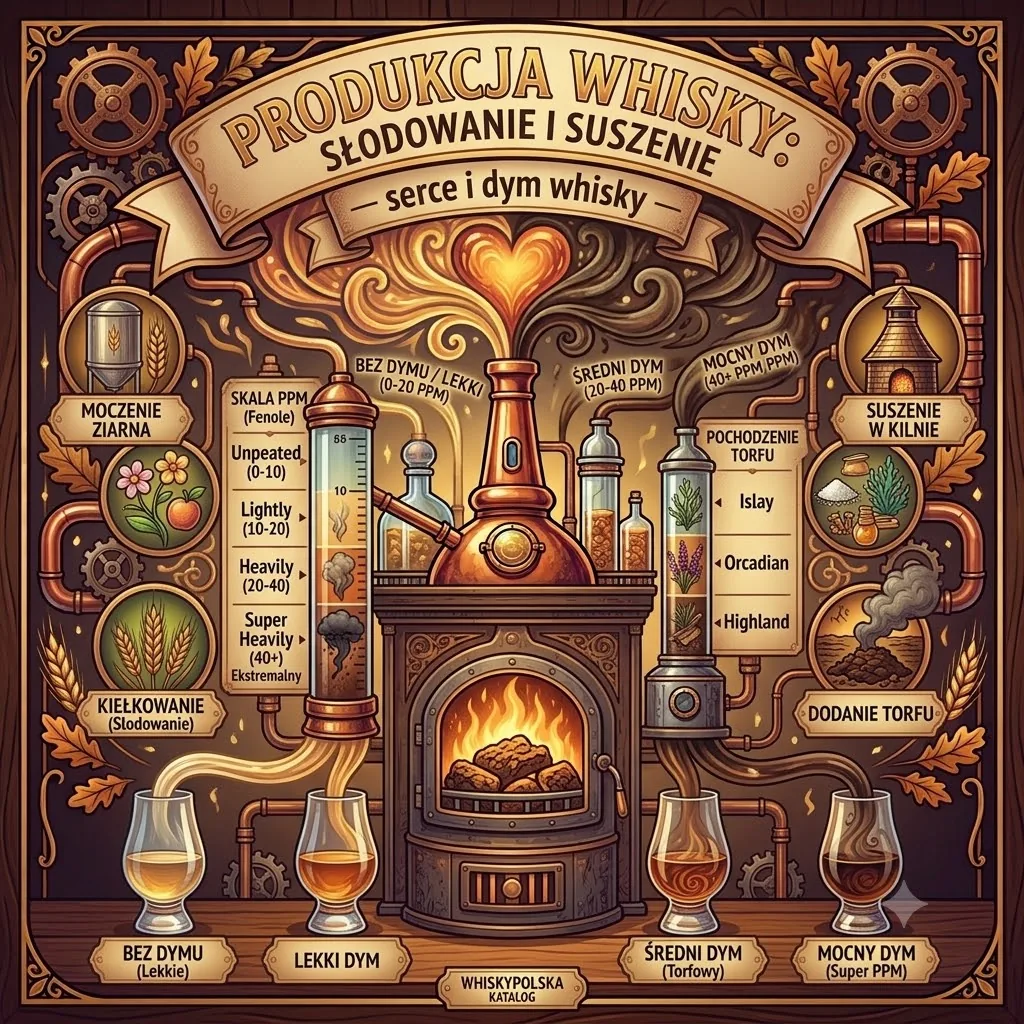
Before Scotch whisky reaches an oak cask for its long years of rest, something has to happen that resembles a controlled piece of biological trickery. It all begins with three simple ingredients: water, yeast and the humble grain of barley. Raw grain, however, is useless to yeast — the starch locked inside it cannot be digested.
To unlock the hidden potential of the sugar, the Scots had to learn to manipulate nature. This crucial first stage of production is malting, followed by kilning. This is exactly where the foundation of whisky's future flavour is born.
The malting process: outwitting the barley
Malting is nothing more than persuading the grain to grow, then brutally interrupting that process at the perfect moment. The aim is to activate the enzymes that will turn hard starch into easily fermentable sugars.
- Steeping — around 2–3 days. The dry grain goes into great vats of water. The barley drinks the water and its moisture content rises dramatically (from around 12% to almost 45%). To the grain this is a clear signal: "spring has come, time to grow".
- Germination — around 5–7 days. The damp grain is spread out in a thick layer and begins to push out little shoots (green malt). Inside, the enzymes that break down the cell walls of the starch awaken. The grain produces a great deal of heat, so it has to be turned constantly to stop it fermenting on the floor.
- Kilning — around 1–2 days. Once the enzyme level is optimal, the process has to be stopped at once. The malt goes into a special kiln, where hot air (often with added smoke) lowers the grain's moisture to around 4–5%. Germination ceases, and the malt becomes crisp, sweet and ready for the next stages.
Floor malting: a dying craft
These days more than 95% of Scottish distilleries buy ready-made malt from vast, industrialised commercial maltings. A handful of traditionalists, however, still maintain their own floor malting.
It is extraordinarily hard physical work. The workers (the maltmen) have to turn tonnes of barley by hand every few hours with heavy wooden shovels, to ensure a supply of oxygen and an even temperature.
A trade curiosity: For centuries this back-breaking work with the arms caused the workers a particular wearing of the joints, which left one arm hanging lower than the other. In Scotland the condition earned the colloquial name "monkey shoulder" — and it's precisely this historical affliction that gave its name to a popular blended malt whisky (Monkey Shoulder).
Today only around 7–8 distilleries in Scotland still maintain their own malting floors (among them Laphroaig, Balvenie, Bowmore, Highland Park and Kilchoman). Even so, they cover only a fraction of their needs (usually 10–30%). The one Scottish bastion that floor-malts 100% of its barley is the legendary Springbank distillery in Campbeltown.
Kilning and the magic of peat: where does the smoke come from?
Once the malt has germinated, it's time for kilning. Above the buildings of traditional distilleries you can see the distinctive roofs shaped like Asian pagodas. They were designed at the end of the 19th century by the architect Charles Doig — their job was to generate the perfect chimney draught, which drew the moisture out of the grain drying on the floor below.
What is burned in the kiln defines the style of the Scotch whisky:
- Clean hot air (no smoke): gas or smokeless coal (anthracite) is used. This gives a light, clean whisky, strongly cereal and fruity.
- Peat smoke: peat is added to the fire — a dense organic matter of mosses and roots, compressed over thousands of years. Peat generates a thick, acrid, oily smoke rich in chemical compounds called phenols.
The damp, germinating grain acts like a sponge — the smoky phenols cling to the outer husk of the barley and stay in it for good, carrying through the following stages all the way to the finished bottle. The level of "phenolation" of the malt is measured in PPM (Parts Per Million).
A comparison: how do the best distilleries kiln?
Every region and distillery has its own recipe for how long to expose the grain to peat smoke:
| Distillery | Region | Kilning style and PPM level | Character |
|---|---|---|---|
| Glengoyne | Highlands | 0 PPM (no peat) | Dried with warm air only. Zero smoke, maximum aromas of apple, toffee and clean malt. |
| Highland Park | Orkney | around 20 PPM (local peat) | Local, heathery peat from Orkney. The smoke isn't medicinal but sweet, honeyed and heathery. |
| Laphroaig | Islay | around 40–45 PPM (maritime peat) | They malt some of their grain themselves, burning peat full of iodine, seaweed and salt. The famous "medicinal" aroma of bandages and tar. |
| Octomore (Bruichladdich) | Islay | from 80 to over 300 PPM! | The absolute extremist — the smokiest whisky in the world. |
The malting and kilning process is the moment when Scotch whisky receives its genetic code. This craft shows that long before technology stepped into the laboratories, Scottish distillers were able to intuitively master the biology of the grain and the chemistry of smoke.
Read on
This article is part of the series The Art of Making Whisky — a step-by-step guide from grain to glass.
- → Next step: Mashing