In the previous step we awakened the enzymes in the barley grain and stopped that process with thick smoke or hot air. We now have the perfect, crisp malt. But for the yeast, which has the next great task to perform, that's still not enough — it cannot "bite into" dry grain.
It's time for mashing. This is the stage ruled by physics, chemistry and the precise handling of water temperature. Here we turn the solid grain into a sweet, clear liquid that will become the fuel for alcohol production.
The anatomy of grist: the magic 20-70-10 ratio
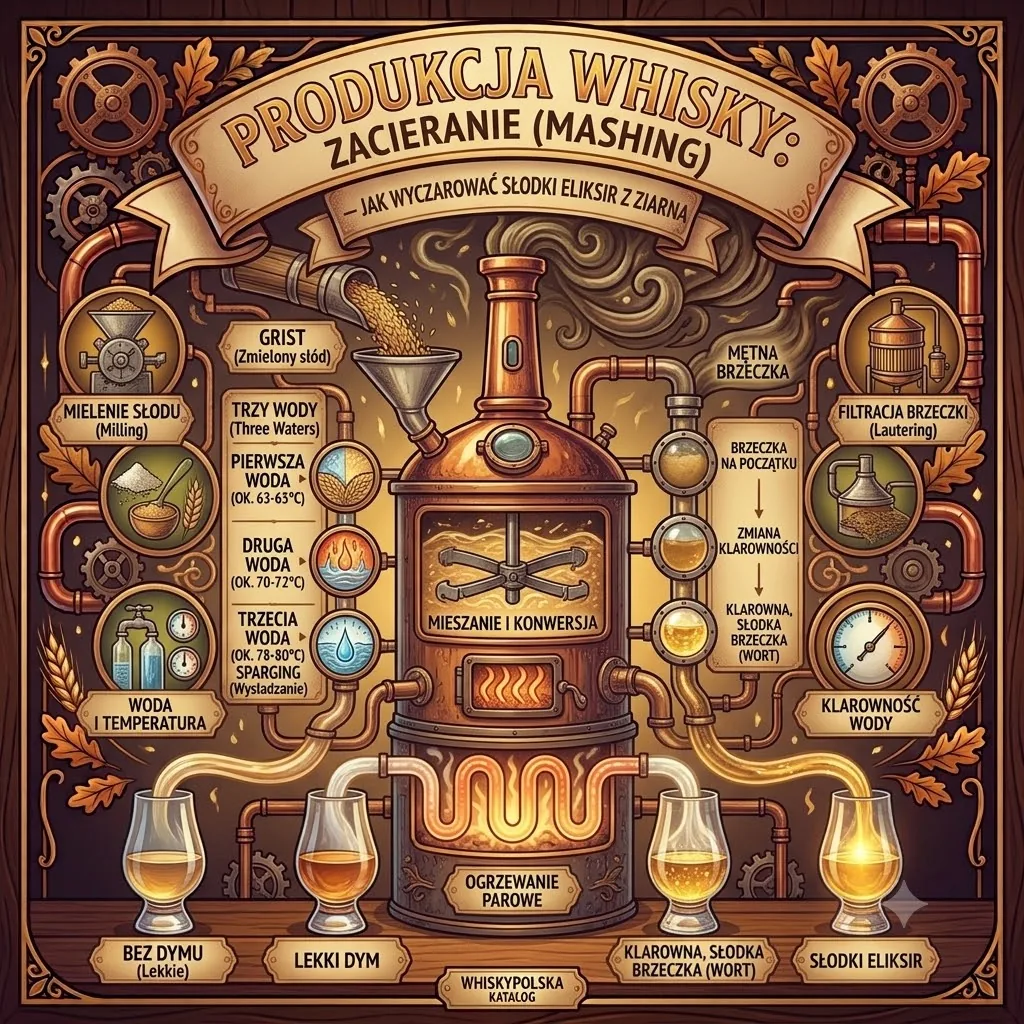
Before the malt goes into the water, it has to be ground in a powerful, traditional mill (most often of the iconic, near-indestructible Robert Boby make). The result of this milling is the grist — a particular malt flour.
The milling cannot be left to chance. Too fine — and the mash tun produces a sticky, unfilterable stuck mash. Too coarse — and the water won't reach the starch and we lose precious sugar. Every distiller aims for the ideal, sacred grist ratio:
- 20% husks — they contain no sugar, but form a natural filter at the bottom of the tun.
- 70% grits (smalls/middlings) — the heart of the grist, fine particles from which the sugar is most easily washed out.
- 10% flour — the finest fraction, which gives up its starch in an instant.
Three waters, or the dance with temperature
The finished grist goes into a great mash tun. Mixing with hot water follows — but not "all at once". To squeeze absolutely everything out of the grain, a traditional process of three (and sometimes four) water charges is used, each one hotter than the last.
| Water charge | Approximate temperature | Role in the process |
|---|---|---|
| First water | 63–65°C | The most important. The enzymes (alpha- and beta-amylase) wake up and break the starch down into maltose. Too cold — the process won't take place; above 67°C — the enzymes are irreversibly destroyed. |
| Second water | 75–78°C | Washes out the remaining sugars. Hotter, to liquefy the starch, but not so hot as to release the bitter tannins from the husks. |
| Third water | 85–90°C | A rescue role. Kills off the last of the enzymes and recovers the final sweetness. This liquid doesn't go into production — distilleries use it as the first water for the next mash, saving energy and sugar. |
What is wort, and what is a washback?
Plenty of myths have grown up around brewing and distilling terminology, so it's worth setting them straight:
- Wort: the sweet, sticky liquid we draw off from the mash tun after the first and second charges. In appearance it resembles cloudy apple juice. It's full of maltose and ready to meet the yeast.
- Washback: a small technical note — the washback plays no part in the mashing itself. It's the large fermentation vessel (wooden or steel) into which the finished wort, cooled to around 20°C, is pumped for the next few dozen hours.
How does mashing affect a whisky's style?
Mashing isn't just the mechanical extraction of sugar — it's the moment when the Master Distiller decides on the weight and character of the future spirit. The key is the clarity of the wort.
Clear wort
If the liquid is drawn off slowly and gently, and the husk layer filters it perfectly, we obtain an almost transparent wort. The absence of solid particles means the yeast works calmly, which translates into the formation of a large quantity of esters.
- Effect on flavour: a light, clean, very fruity whisky, with grassy and citrus notes (the style characteristic of, for example, Glenfiddich or The Glenlivet).
Cloudy wort
If a distillery is pressed for time, or deliberately mashes aggressively, fine solid particles and fats find their way into the wort. The yeast reacts to them differently, producing more heavy, oily and sulphurous aromas.
- Effect on flavour: a powerful, meaty whisky, with cereal, nutty and biscuity notes and an oily texture (a style represented by, among others, the bestsellers from Islay and the Craigellachie distillery).
Once the sweet wort has run down into the washbacks, it's time to hand the stage over to the microorganisms.
Read on
This article is part of the series The Art of Making Whisky.
- ← Previous step: Malting and kilning
- → Next step: Fermentation