Jura
Islands
Scotland
About
It might be reasonably assumed that Jura would make a peaty whisky. After all, the island is smothered in the stuff. It was, however, built in the 1960s with backing from a major blender, Mackinlay, and at that time light whisky was what was needed. Jura, therefore, conformed to the requirements of the market.
History
Although the large southern Hebridean island of Jura has always been sparsely populated, it has a fascinating distilling heritage. In the 18th century, it was reported that islanders made spirit from rowan berries, as well as using the bitter fruit to acidulate their whisky punch.
Illicit distillation took place, but there was a legal site in the island’s only settlement, Craighouse, in 1810 licensed to the island’s owner Archibald Campbell. There is debate as to whether there was a legal distillery in Lagg.
The distillery went through a number of names: Craighouse, Small Isles, Caol nan Eilean, Jura, and various owners without garnering any great fame until 1901 when it was among many to close in whisky’s first great sales slump. The cost in running a remote island site is always expensive, and a lack of direct transport to the mainland (all ferry traffic still has to go via Islay) also counted against its survival.
It was these economics which ruled Jura out of the distilling equation for over six decades. Then, in 1963, two of the island’s landowners, Robin Fletcher and Tony Riley-Smith, decided to start whisky-making once more – predominantly as an incentive to stop any further decline in the island’s population. With financial backing from Leith-based blender Charles Mackinlay & Co, the famous designer William Delme-Evans was hired and a large, modern distillery was built which was further expanded in 1978 to its current size. In 1985, Invergordon Distillers bought Mackinlay and from there the firms were folded into Whyte & Mackay .
It began being sold as single malt in 1974, and the range has grown steadily since. The start of peating saw some smoky whisky being included in the no-age Superstition brand, launched in 2002, while a 100% smoked Prophecy was released in 2009.
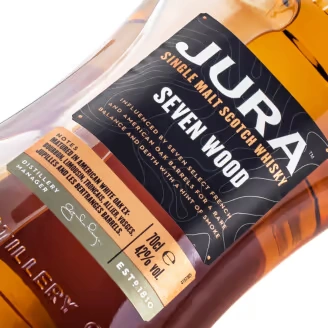
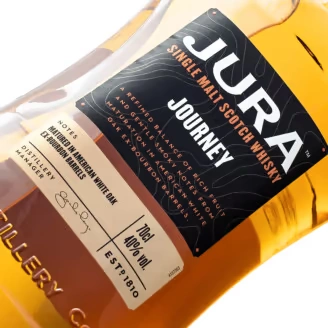
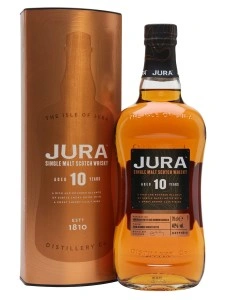
In 2018, Jura underwent a radical revamp, introducing a completely new range of whiskies with a lightly smoky character, from the entry-level NAS expression Jura Journey through 10-, 12- and 18-year-old malts, plus Jura Seven Wood. Further expressions, including Jura Time and Jura Tide, have been launched into travel retail.
Timeline
- 1810 Small Isles Distillery is founded on the Isle of Jura by Archibald Campbell
- 1853 Richard Campbell leases the distillery to Norman Buchanan
- 1867 Buchanan goes bankrupt, and J&K. Orr assume control
- 1876 The distillery's licence is acquired by James Ferguson & Sons
- 1901 At the start of the 20th century the distillery is closed and stripped bare
- 1960 Charles Mackinlay & Co rebuilds and extends the distillery; in the same year the business is purchased by Scottish & Newcastle Breweries
- 1963 Spirit spills from Jura's stills for the first time in the 20th century
- 1974 Jura appears as a single malt for the first time
- 1985 Invergordon Distilleries purchases Isle of Jura
- 1993 Whyte & Mackay takes over Invergordon Distillers
- 2002 Jura launches Superstition
- 2007 Whyte & Mackay is taken over by Indian group United Spirits
- 2009 Peated malt, Prophecy, is launched
- 2014 Whyte & Mackay is sold on to Filipino company Emperador for £430m
- 2018 A wholly new Jura range is introduced, with a new, lightly smoky, flavour character
Production facts
- Capacity (mlpa)
- 2.2
- Condenser Type
- Tube
- Fermentation Time
- 54hrs
- Filling Strength
- 63.5%
- Grist Weight (t)
- 4.75
- Heat Source
- Steam pans and coils
- Malt Specification
- 0-0.5ppm
- Malt Supplier
- Bairds
- Mash Tun Type
- Semi Lauter
- New-make Phenol Level
- 0ppm
- New-make Strength
- 71%
- Spirit Still Charge (l)
- 4,500
- Spirit Still Shape
- Lantern
- Stills
- 4
- Warehousing
- Racked
- Wash Still Charge (l)
- 24,150
- Wash Still Shape
- Lantern
- Washback Size (l)
- 48,300
- Washbacks
- 6
- Water Source
- Market Loch
- Yeast Type
- Kerry
Ownership
Current owner
Parent company
Previous owners (7)
The Campbell Family
1810–1853
Norman Buchanan
1853–1861
J&K Orr
1867–1876
James Ferguson & Sons
1876–1901
Charles Mackinlay & Co
1960–1960
Scottish & Newcastle Breweries
1960–1985
Invergordon Distillers
1985–1995