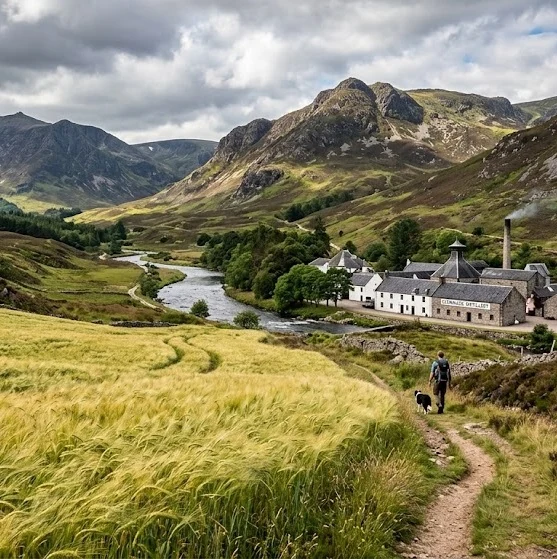
Three simple ingredients: clean water, grains of barley and microscopic yeast. Add an oak cask and the most luxurious factor of all — time. It's remarkable that from such a modest set people learned to create one of the most complex and prized spirits in the world.
Although every glass of single malt holds decades of tradition and the unique microclimate of a distillery, from a technical point of view the whisky-making process has been unchanged for centuries. It's a beautiful, craftsman's journey set out across six main stages. Here's what that road looks like from a bird's-eye view.
The road to perfection: a production timeline
Each of the stages below has a dramatic impact on what you'll ultimately taste in your glass. A single mistake at any of these steps can undo years of work. We've also covered each one in its own detailed article — click through to dig deeper.
1. Malting and kilning — waking and sending the grain back to sleep
The barley is steeped so that it begins to germinate and releases its enzymes, then dried in great kilns. If we add peat to the fire, the whisky takes on a smoky, medicinal character. If we use only hot air, it will be fruity and light.
2. Mashing — pressing out the sweet juice
The dried grain is milled into a particular flour (grist) and mixed with hot water in huge mash tuns. The goal? To dissolve the sugars and obtain a sweet, clear liquid called the wort.
3. Fermentation — the yeast comes into play
The cooled wort goes into large fermentation vessels (washbacks). Yeast is added, and over the course of a few dozen hours it greedily devours the sugar, producing alcohol and carbon dioxide. What results is the wash — a liquid resembling a strong, unfiltered beer of around 8–10% ABV.
4. Distillation — the magic of copper and fire
The "beer" goes into copper stills. Because alcohol boils at a lower temperature than water, the vapours rise, condense and travel to a second still. After a double (or triple) distillation we obtain a colourless, powerful spirit of around 70% ABV — the so-called new make.
5. Maturation (ageing) — patience in oak
The fresh distillate is filled into oak casks (most often ex-bourbon or ex-sherry) and shut away in cool, dark warehouses. In Scotland the law requires it to rest there for a minimum of 3 years. This is where the whisky gains its golden colour and 60–70% of its final flavour and aroma.
6. Finishing and bottling — the final touch of the craft
When the casks reach maturity, the Master Blender selects the best of them. They may bottle a single, exceptional cask (single cask) or marry dozens of them to preserve the consistent, iconic flavour of a distillery's flagship release.
Where is character born?
Although it sounds like pure engineering, there's no room for soulless automation in whisky-making. Every distillery has its secrets. The shape of the copper stills (squat and bulbous vs. tall as giraffes), the type of wood used to make the casks, even the proximity of the ocean, whose salty air "breathes" through the pores of the oak staves — all of it creates a spirit's unique DNA.
Understanding these details turns an ordinary tasting into a fascinating journey and lets you look at the price of a good bottle in a completely different light.
What next? Each of these steps is a separate, fascinating story. Do you know why workers at traditional maltings suffered from "monkey shoulder" syndrome, and just how much influence the smoke from thousand-year-old peat has on flavour? Start with the first, foundational step: Malting and kilning — the heart and the smoke of whisky.