In the previous step, thanks to the mashing process, we obtained wort — a sweet, sticky liquid. Although it smells promising, it doesn't yet contain a single drop of alcohol. To change that, we need to invite living organisms to the table.
Fermentation is the stage where technique gives way to biology. It's a process lasting a few dozen hours, during which unassuming yeast carries out a spectacular transformation of the wort, laying the foundations for the aromatic palette of the future whisky.
The role of yeast: more than an alcohol factory
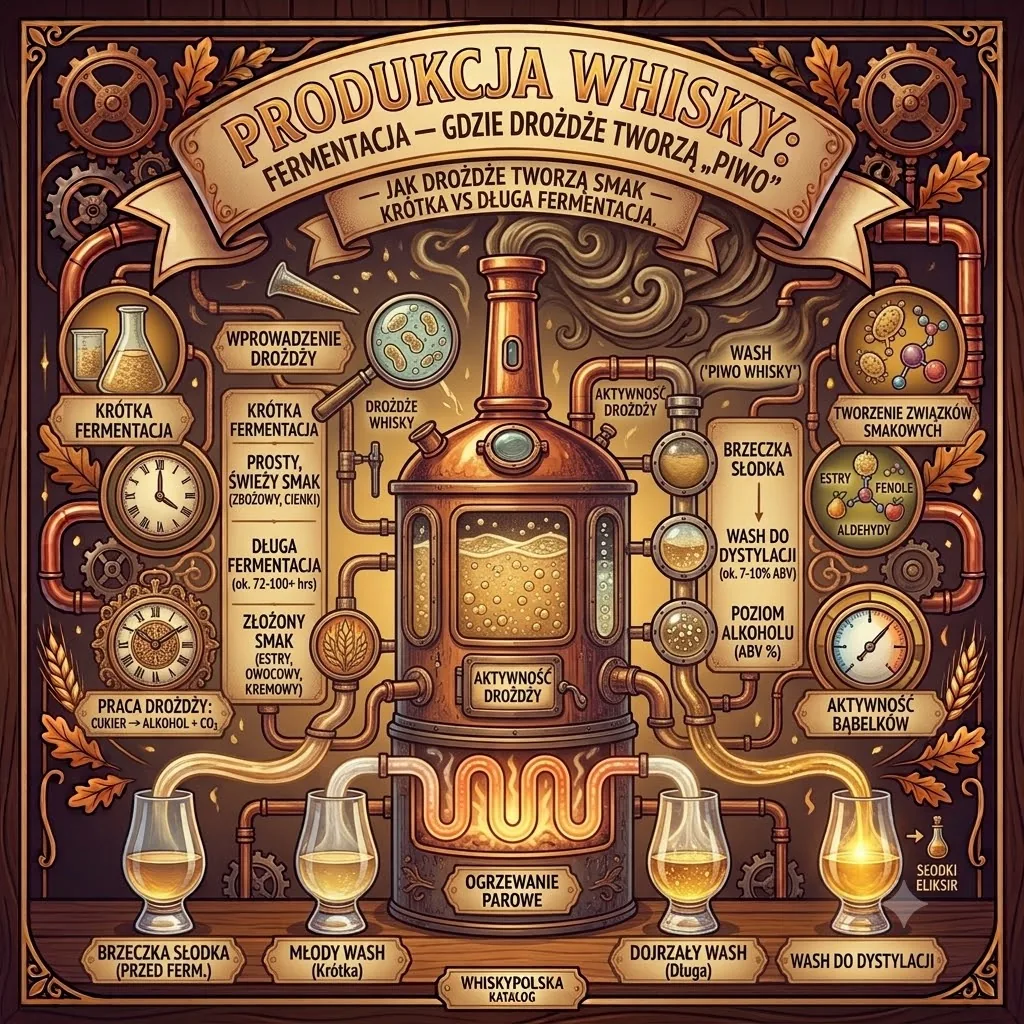
The main job of distiller's yeast (most often strains of Saccharomyces cerevisiae) is to eat the sugars in the wort and convert them into ethanol and carbon dioxide. If it were only about pure alcohol, making whisky would be no different from making vodka.
For the distiller, yeast is above all a flavour generator. During its vigorous work it produces organic compounds called congeners (esters, higher alcohols, fatty acids). These are responsible for the fruity, floral and spicy notes in whisky.
Time matters: short vs long fermentation
- Short fermentation (48–50 hours): the yeast works quickly and aggressively. The liquid keeps a strong cereal character, with notes of fresh malt, nuts and biscuits.
- Long fermentation (60 to over 100 hours): after about 50 hours the yeast begins to die off from lack of food. Lactic acid bacteria come to the fore, carrying out a secondary malolactic fermentation. The result? Plenty of esters (ripe apples, pears, bananas) and a buttery, creamy texture.
A clash of worlds: wooden vs steel washbacks
After mashing, the liquid is cooled to around 20°C (a higher temperature would kill the yeast) and pumped into huge fermentation vessels, known in Scotland as washbacks. The industry has debated this for years: traditional wood or modern steel?
| Feature | Wooden washbacks (larch, Oregon pine) | Stainless steel washbacks |
|---|---|---|
| Tradition and aesthetics | Iconic look, the scent of old Scotland. | Modern, almost laboratory-like design. |
| Hygiene and cleaning | Difficult. Wood is porous, and colonies of "good" bacteria live in its crevices. | Easy to sterilise with automated systems. |
| Temperature control | Wood is a great insulator — it naturally holds the yeast's warmth. | Requires external cooling jackets. |
| Impact on flavour | Bacteria in the pores boost the acidity and fruitiness of the spirit. | Full repeatability, a clean and controlled profile. |
Distilleries such as Balvenie and GlenAllachie proudly show off rows of wooden washbacks, believing in their biological magic. Precision-focused giants such as Caol Ila and The Glenlivet, on the other hand, mostly opt for gleaming steel.
A glossary: wash vs low wines
These two terms are easy to confuse, because both describe alcohol at an early stage of production.
A small clarification to begin with: while the first of these terms is a direct result of fermentation, the second already belongs formally to the next stage — distillation.
- Wash (fermented liquid): the direct end product of fermentation. A cloudy, frothy liquid of around 8–10% ABV, tasting like a strong, sour, unfiltered craft beer. It's the wash that gets pumped into the first still.
- Low wines: you won't find this liquid yet at the fermentation stage. It only appears after the wash has been heated in the first still (the wash still) — a clear liquid of around 20–25% ABV, an intermediate product waiting for a second distillation.
After a few dozen hours in the washback we have a finished wash — living, bubbling alcohol. Time to hand the wheel over to physics.
Read on
This article is part of the series The art of making whisky.
- ← Previous step: Mashing
- → Next step: Distillation