In the previous step the yeast did its punishing work, leaving us with wash — a cloudy, sour "beer" of around 8–10% ABV. If we now sealed this liquid in a cask, years later we'd end up with something undrinkable rather than a fine spirit.
For whisky to be born, we have to enter the world of physics, thermodynamics and… the magic hidden in copper shapes. Distillation is the process of purifying, concentrating and sculpting the character of the alcohol.
Copper — the most important (and invisible) purifier
Stills gleam in the sun and look photogenic, but the choice of copper isn't a matter of aesthetics. Copper is a crucial, chemically active element of production.
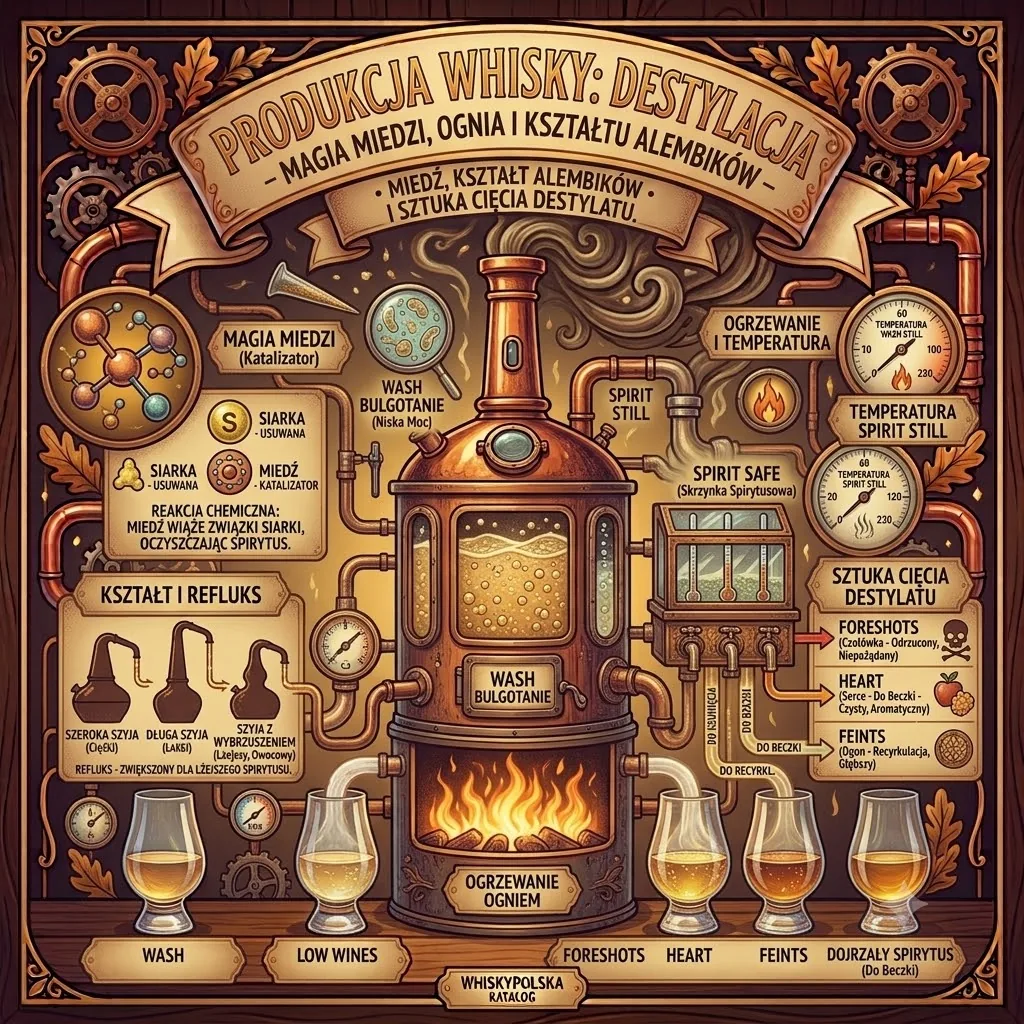
During fermentation, yeast produces not only alcohol but also unpleasant sulphur compounds (smelling of rotten eggs or boiled cabbage). Copper acts as a giant filter and catalyst — it reacts with the sulphur, binds it to its walls and permanently removes it from the spirit.
The rule is simple: the longer the alcohol vapours stay in contact with copper, the cleaner, lighter and fruitier the final spirit will be.
The anatomy of a still: why does shape matter?
In Scotland no two distilleries have identical stills. Every dent, every narrowing, every neck height is deliberately designed, because they govern a phenomenon known as reflux (the return of vapour) — when heavier vapours cool before reaching the top and flow back down to the bottom, forced to be distilled again.
The height of the still's neck
- Tall as giraffes: at Glenmorangie the stills are over 5 metres tall. Only the lightest, purest molecules reach the very top — the result is an exceptionally delicate, fruity whisky.
- Short and squat: at The Macallan or Lagavulin the stills are small and stocky. Heavy, oily vapours easily cover the short path to the condenser — the result is a meaty, heavy profile.
The angle of the lyne arm
- An upward-angled arm: acts as an extra filter. Heavy vapours flow back down (lots of reflux = a light style).
- A downward-angled arm: gravity helps the vapours — everything reaches the condenser (little reflux = a heavy, full style).
The Scottish standard: a dance in two acts
Most Scottish distilleries use double distillation (an exception is, for example, Auchentoshan, which follows the triple tradition).
- Wash still — the first, larger still. This is where the fermented wash (8–10%) ends up. The collected and condensed vapours give a clear liquid of around 20–25% ABV, called low wines.
- Spirit still — the second, smaller still. The low wines go back for distillation. This is where the real flavour sculpting happens — the spirit flows more slowly, and its strength rises to over 70%.
The art of the cut: head, heart and tail
The spirit from the spirit still flows into a brass cabinet locked behind glass, the spirit safe. The stillman divides it into three fractions:
- Foreshots (the head): the first minutes. Very strong, but containing toxic methanol and harsh compounds — it smells of nail varnish remover. Discarded (returned for re-distillation).
- The Heart: the Holy Grail of the process. A crystal-clear spirit of around 65–68% ABV, smelling of fruit and grain. Only this part — the new make spirit — will go into casks.
- Feints (the tail): the end. The strength drops, the alcohol becomes heavy, sulphury and oily. Cut off and returned.
The moment the stillman decides to cut from heart to tail decides everything. With peated whiskies (such as Ardbeg or Laphroaig) the cut is made deliberately later — the desirable, smoky phenols are only released right at the end of the process.
The colourless, powerful new make is just now leaving the still room. Its most important test lies ahead — years in a dark, damp warehouse.
Read on
This article is part of the series The art of making whisky.
- ← Previous step: Fermentation
- → Next step: Maturation (ageing)