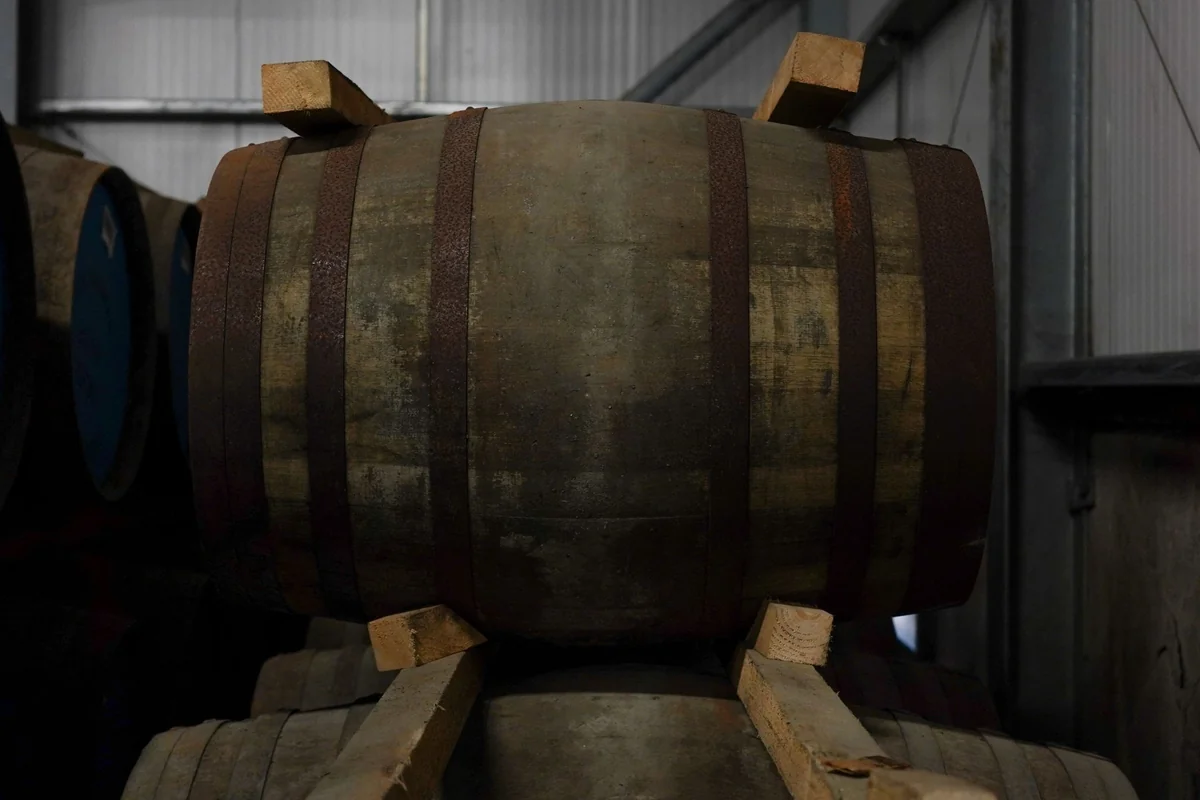
Colourless, harsh and fiery — that's the new make spirit leaving the copper stills. In this state it has no right yet to call itself Scotch whisky. The rules are uncompromising: the spirit must spend a minimum of 3 years and one day in an oak cask on Scottish soil.
But three years is barely a warm-up. Industry research is blunt: from 60% up to as much as 80% of the final flavour, and 100% of the colour, of whisky come exclusively from the wood. How can an ordinary oak log create such a complex spirit?
Why oak in particular?
Oak is the only tree that combines two contradictory qualities: it's hard and dense enough that it won't let the liquid leak out, yet porous enough to let the whisky "breathe" and react with the air.
What's more, the inside of every cask is subjected to charring before it's filled. The charred layer of oak acts as a final, natural carbon filter — absorbing any remaining imperfections in the young spirit.
The three acts of maturation: how wood sculpts the spirit
- Subtractive maturation: in the early years the cask "takes away" the alcohol's aggression and harshness. The charred layer removes sulphury and metallic notes.
- Additive maturation: the alcohol leaches natural compounds out of the wood — vanillin from the lignin, coconut and buttery notes from the oak lactones, and the desirable tannic grip and structure from the tannins.
- Interactive maturation: the cask shrinks and expands with temperature changes. The alcohol constantly "travels" deep into the staves, and the oxygen reaching it through the pores slowly turns harsh aromas into smooth notes of dried fruit and honey.
A clash of worlds: American bourbon vs Spanish sherry
Under Scottish law a cask must be oak, but it doesn't have to be new. The Scots almost never use fresh wood — they buy casks that previously held another spirit. This defines the flavour profile:
| Feature | Ex-bourbon casks (American oak — Quercus alba) | Ex-sherry casks (European oak — Quercus robur) |
|---|---|---|
| Popularity | Dominant (around 85–90% of all casks in Scotland). | Rarer, far more expensive (can be 10× the price). |
| Aromatic profile | Vanilla, caramel, coconut, honey, crème brûlée, citrus. | Dark fruit (raisins, figs, dates), chocolate, nuts, cinnamon, cloves. |
| Spirit colour | Pale gold, straw, amber. | Deep mahogany, dark amber with ruby glints. |
| Iconic examples | Glenmorangie Original, Laphroaig 10, Balvenie DoubleWood. | Macallan Sherry Oak, Glenfarclas, GlenDronach. |
The Angels' Share — the cost of perfection
A cask is not a perfect safe. Through the pores of the oak staves, part of the contents constantly escapes. In Scotland's cool, damp climate, casks lose around 1.5–2% of their volume each year. Distillers poetically named this escaping alcohol the Angels' Share.
The maths of the cask: if you seal a cask for 20 years, the angels will drink nearly 30–40% of its original contents. That's why older whiskies are so expensive — you're paying not only for time, but also for liquid that has vanished irretrievably into the Scottish clouds.
As the volume drops, so does the alcohol strength (on average 0.5% a year). If the level falls below the legally required 40% ABV, the liquid officially stops being whisky.
Warehouses: where time flows differently
- Dunnage warehouses (traditional): low buildings with thick stone walls and an earthen floor. Casks are stacked a maximum of 3 high. High humidity and a stable, low temperature — the whisky matures slowly, earthily, classically.
- Racked warehouses (modern): vast halls with steel racks, casks stacked even a dozen or more levels high. Greater temperature swings — maturation that's faster and more predictable.
After years in oak's embrace, the whisky reaches its peak. It's time for the final stage — a meeting with the person who will give it its finishing touch.
Read on
This article is part of the series The art of making whisky.
- ← Previous step: Distillation
- → Next step: Finishing and bottling